
'Both Abdul Hamid and the enemy tank place each other in their sights and shoot. Both shells hit their targets. There is a loud blast, fire and smoke.' 'Hamid doesn't get time to jump off. A deafening blast follows and then there is complete silence.' 'Abdul Hamid is dead. He has destroyed a total of seven enemy tanks, many more than what an armoured formation could take on.'
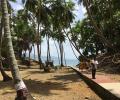
The government has decided to name 21 uninhabited islands in the Union territory of Andaman & Nicobar after recipients of Param Vir Chakra, the country's highest wartime gallantry award.
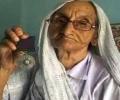
The family of Param Vir Chakra awardee Abdul Hamid has expressed outrage after his name was removed from the main gate of a primary school in Ghazipur, Uttar Pradesh, where he once studied. The school, which was renamed "PM Shri Composite School" after a recent painting work, previously bore the name "Shaheed Hamid Vidyalaya." Despite the family's complaints, the school authorities have yet to reinstate Hamid's name on the main entrance, leaving the family deeply hurt. Abdul Hamid was a war hero who displayed extraordinary bravery during the 1965 India-Pakistan war, destroying three Patton tanks and forcing the enemy to retreat.

The aggrieved family members said the hospital authorities did not conduct any COVID-19 test on Ali Hasan (61), the second son of Param Vir Chakra recipient Abdul Hamid.

In spite of being wounded in battle, Lieutenant Colonel A B Tarapore fought for six days before meeting a hero's death on the battlefield in the 1965 war. A legend in the Indian Army, he is the highest ranking officer to be awarded the Param Vir Chakra.
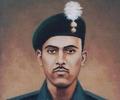
The school, located in Dhamupur village under Jakhanian tehsil, about 35 km from the district headquarters, was originally named after Param Vir Chakra awardee Abdul Hamid, who studied there during his childhood.

On January 23, the N D Modi government named 21 uninhabited islands in the Union Territory of Andaman and Nicobar after recipients of Param Vir Chakra, the country's highest wartime gallantry award.
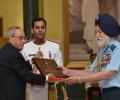
President Pranab Mukherjee on Tuesday hosted a high tea for 1965 war veterans in the Rashtrapati Bhavan complex as the country celebrated the golden jubilee of the war with Pakistan.

10 Heroes of the 1965 War which ended on September 23 60 years ago.

'A man dies and it's over for him. But we're right here, it isn't over for us,' she says cryptically. She talks about the "poverty" in which she had to raise her sons and daughter, the responsibility of today's youth to its country and how war widows should cope with their loss.

A thrilling vertical manoeuvre by Su30 fighter jets and performance by motorcycle-borne soldiers among a host of other activities today cast a spell over thousands of people who attended the carnival 'Indradhanush' at the Rajpath in New Delhi to commemorate the golden jubilee of the 1965 Indo-Pak War.

In a ceremony on Monday on the occasion of Parakram Diwas, Prime Minister Narendra Modi named the 21 largest unnamed islands of Andaman and Nicobar after Param Vir Chakra awardees.

The Indian Army has removed several colonial-era vestiges from its dress regulations, the mandatory carriage of swords by Reviewing Officers, and the use of pouch belts with certain mess dresses. It has also dropped the use of archaic terminology such as "Royal".

'News is rife that Pakistan will attack the next day. They have no idea that this is where they will take on the might of 1 Armoured Division of Pakistan in a three-day bloody battle that will be remembered in military history as the Battle of Asal Uttar.' Rachna Bisht Rawat salutes the brave men turned the tide of the '65 war.
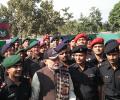
For the second successive year, Prime Minister Narendra Modi celebrated Diwali with troops on Wednesday, saying the world looks at India with respect because of their valour and "character", in comments that come against the backdrop of protests by several veterans over OROP.
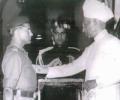
Decorated with a Vir Chakra for leading an attack that destroyed four tanks, Risaldar Ayub Khan shared a name with the Pakistani president who ordered the invasion of India in 1965. India's Ayub came from a family of soldiers and made his country proud.

'It was not surprising that joining the armed forces was one of the priority professions that the students strived for. Probably, the training in school helped adjusting to the regimentalised life of the fauj.'
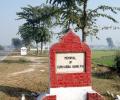
In super-human acts of valour, Havildar Abdul Hamid personally knocked out five tanks over two days, effectively derailing the enemy offensive in the 1965 Indo-Pak War. 'Decades later, I realised not only how much the nation owed to this great son of India but also that my entire family was probably alive thanks to him,' says Vijay Dandapani.

Prime Minister Narendra Modi on Thursday visited Shauryanjali, a military exhibition to mark the golden jubilee of Indo-Pak War of 1965, and said that the valour and sacrifice of the armed forces during the war would remain etched in every Indian's memory.

An old fighter pilot remembers the best days of his life.
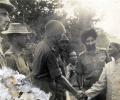
Lieutenant Colonel Desmond Hayde was awarded the Mahavir Chakra, the second highest honour in battle, for winning an epic battle in Pakistan. In a brilliant and gruesome assault, what he and his men achieved that September 50 years ago had never been seen before.

Prime Minister Narendra Modi led the nation in paying tributes to the valour and sacrifices of Bangladeshi freedom fighters and Indian armed forces on the 50th anniversary of the occasion 'Vijay Diwas'.

'It would not be incorrect to say that the Chinese-Pakistani strategy of containing India began in the aftermath of the 1965 war.'

'Pakistan's recent utterances and tendency to use pinpricks to try our patience appear reminiscent of 1965. We are a strong nation, emerging stronger,' says Lieutenant General Syed Ata Hasnain (retd).

50 years after the 1965 War, India still thinks we can have a 'limited war' when our opponent has time and again shown it does not believe in a limited war, says Colonel Anil A Athale (retd).

Glimpses of the final days of the 1965 War, as seen from the diary then defence minister Y B Chavan maintained during the war.

'We don't know what the reasons were that we gave back the Haji Pir Pass which was strategically very important. Today the entire infiltration into Kashmir takes place from that area. If we had retained that post that we had captured, things could have been different.' 'A lesson we need to learn is if you start losing the gains of war at the negotiating table, they become a disincentive for future wars,' says Lieutenant General D B Shekatkar (retd), reviewing the lessons from the 1965 War.

'The Indian Air Force wanted to fight. My squadron leaders and flight lieutenants, all of us were eager to fight. Unless they are keen I can't have confidence.' Marshal of the Air Force, the legendary Arjan Singh, on the 1965 War.

'We were firing at Patton tanks that were moving towards India.' 'Fighter aircraft are the biggest menace for tanks because they come at great speed, attack from a height and their rockets are lethal.' 'The Hunter travels at 400, 420 knots. One knot is 1.6 times a km, so it was at a speed of 700, 800 km/hr.' 'You come at great speed and when you see the tanks, you pull up because attacks are always done in a dive.' 'You go up to 3,000 to 4,000 feet and then dive on to the target and let off your rockets...'

Modi took on the opposition parties, especially the Congress, saying it is the corrupt who are sleepless now.
'My wife, family members as well as members of the workers will be trustees.' 'The trust will take all decisions -- no family member can individually take any decision.'

'A close look at the time-lines tells you that exactly as the back-channel negotiations were in their most crucial stage, "somebody" was planning the 26/11 attacks in Mumbai,' says Shekhar Gupta questioning Khurshid Mahmud Kasuri's account of a peace deal with India.
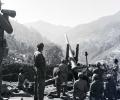
Fifty years ago, India and Pakistan fought a short but bloody war. The author finds out how Sainik Samachar, the defence ministry's journal, reported it.
